





Improve Conditions, Make Value Flow
In a current project, several community health centers are working to increase the number of patients with diabetes who get timely oral health care. There’s a connection between glucose control and oral health; community health centers that provide dental services as well as medical care are well-placed to leverage this connection to improve the health of their patients.
Our project has outlined several changes to integrate medical and oral health care. A medical team member asks the patient questions about their oral health and the last visit to a dentist, then the doctor or mid-level provider looks in the mouth to check for obvious problems with teeth or gums. In most cases, the patient is offered a referral to the center’s dental team to initiate regular care.
In an ideal world, we can imagine that the referral to the dental team would result in immediate dental care; the patient would have the time for the appointment the same day as their medical visit and the dentist or hygienist would be ready to do the work. Sometimes that happens (especially for urgent oral health problems). The more common situation is that a patient gets a dental appointment for care sometime in the future, before they leave the clinic.
The health centers find that 20% or more of patients with diabetes in their test populations who make an appointment do not show up for care. This “no show” issue is a general challenge, not specific to patients with diabetes, and prevents the smooth flow of patient care.
If a patient is on the dental schedule and does not show up for care, that counts as a no-show. (Health centers typically have guidelines for cancellation of a visit; that’s an important detail we won’t dive into in this discussion.)
A no-show means the patient did not get the care that was planned. A no-show also disrupts the schedule of work. Dental appointments in almost every health center are precious; there is more demand than capacity. Wasting an appointment slot by a no-show is tragic.
What conditions could be changed to improve the flow of care in health center dental clinics?
Insights from Wood River Health
My colleague, Helen Bell, Director of Dental Operations at Wood River Health, has adapted Wood River’s scheduling system to carefully distinguish between “no-shows” and schedule utilization.
At Wood River, it is possible to have more than one “no-show” event in a day, yet have all the care time available to the dentists and hygienists used productively to treat patients.
Over the past five years, Helen and her team have modified their appointment policy, reminder system, the conversations staff have with patients about appointments, performance measurements, and daily schedule management.
Here’s a sketch of what happens at Wood River as a patient’s dental appointment approaches:
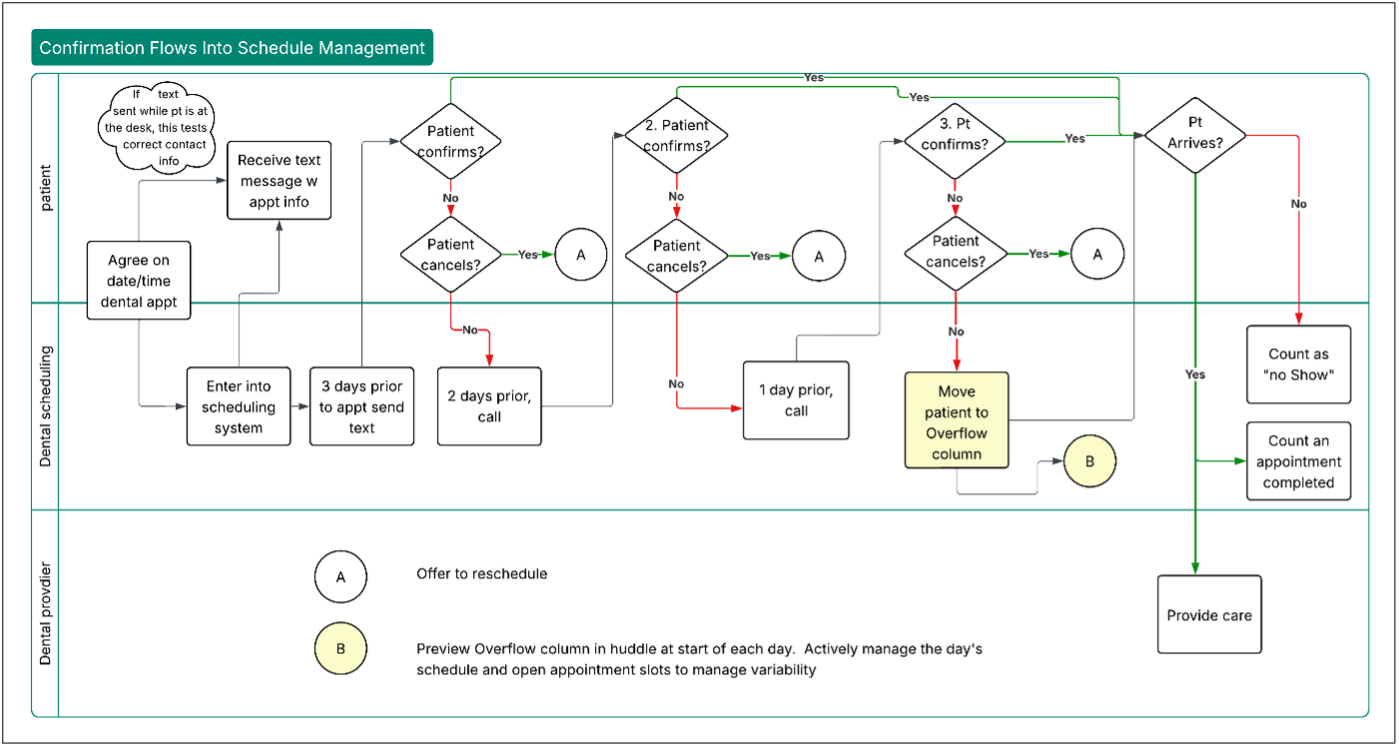
A key change from Wood River’s former practice (highlighted in yellow) involves predicting a patient's no-show event and actively managing the consequences of that prediction. The odds of a patient not showing for an appointment increase if the clinic lacks confirmation.
Suppose a patient with a Tuesday dental appointment has not confirmed by the start of Monday’s clinic hours.
The registration staff moves the patient from the appointed provider’s slot to an overflow appointment at the original time on Tuesday. Now there is an open appointment time on the provider’s schedule —available for another patient who calls for urgent dental care on Monday to be seen on Tuesday, or for a patient who has asked to come in for dental care sooner than their scheduled appointment. Patients with diabetes referred for care are a specific population to offer open appointments.
By the end of Monday, the dental registration staff will know the status of Tuesday’s appointments for all patients and providers, including the number of patients on the overflow schedule and the number of open appointment slots available for other patients who call for same-day care.
First thing Tuesday during the morning huddle, the entire dental staff gets an update on the overflow schedule and the number of open appointments. The Tuesday schedule is dynamic and accessible to everyone. It is managed by staff and clinicians who aim to never waste an appointment slot.
If an overflow patient does not show up at the clinic on Tuesday, the registration team counts the no-show event. (A patient who has confirmed their appointment may also fail to show up. This no-show event is also tracked.) Tracking no-show events is useful for clinic planning and individual patient support.
If an overflow patient does show up at the clinic for their appointment, the registration people explain that the overflow status resulted from missing a confirmation. However, the patient is welcomed—no shaming!-and given options to be seen by a provider as soon as possible, as informed by the clinic schedule.
In February 2026, Wood River had 24 patients who had not confirmed their appointment and were placed in the overflow status. Four of those patients showed up and were all seen. In addition, the dental team was able to accommodate 98 “same-day” patients (15% of their available appointments) –including 12 people with urgent needs and 70 people who were called in so they could get care sooner than their scheduled appointment. Working the dynamic schedule requires daily attention.
In the past, Wood River would block out “urgent/emergency needs” time blocks in the schedule. They have realized this is an unnecessary constraint on their schedule; they can now handle emergency care appointments using their dynamic scheduling.
Wood River still has days with multiple wasted appointments across the dental schedule. However, their system now has a clear aim: to maximize appointment slots, not just to report no-show data every month, which seemed an insoluble problem. The system makes the opportunities visible, gives Helen and her team a method for managing schedule variations, and provides a foundation for testing additional interventions.
Stories from Story Construction
Last week on a Lean Frontiers webinar, Pat Geary from Story Construction spoke with coach and host Oscar Roche about Story's management system. Story has achieved higher efficiency and improved workplace safety through changes to its management practices, driven by the need to attract and retain new employees as the current generation retires.
Pat emphasized that the Story workforce has many experienced people who take pride in getting the job done, despite variable weather, material delivery delays, and challenging construction requirements.
Rather than driving standardization of specific tasks for their creative and skilled workers, Story leaders have chosen to focus on improving the conditions of work as the foundation for better outcomes, efficiency, and safety. The conditions include both the physical set-up of the job site and the information context for each day’s work.
Pat described a project that was seriously behind schedule, involving cladding the exterior of a large building. A project manager took the time to observe the work site carefully. The site’s inventory of cladding material was staged far from the building itself; a large fraction of worker time was spent waiting and moving material, rather than doing the value-added work of redoing the building’s surface. The project manager changed the physical condition of the work, moving the material much closer to the outer walls to make the work faster, easier, and safer.
Pat also described a high-impact change to Story’s daily job-site morning huddle. An analysis of safety incidents indicated that accidents were more likely to occur on days when planned work changes were made at the last minute or when people were uncertain about their responsibilities for the day. The morning huddle now includes a quick check of each person’s responsibilities and tasks for the day, given the up-to-date plan. After Story added this check to the morning huddle, the company experienced a step-up from already good safety performance. The revised morning huddle changed the information conditions of the day’s work, clarifying roles and responsibilities.
Improved Conditions improve the flow of value
Wood River Health and Story Construction have increased value for their patients and customers by reducing delays and wasted effort by their people.
The organizations use daily huddles to keep the work team aware of the day’s critical conditions and to address variations from previous plans and schedules. Critically, the organizations have also been ready to redesign the setup for each day’s tasks—moving materials closer to the work or directing “last-minute” patients to available appointment slots—so that their skilled people can accomplish meaningful work every day.
Decades ago, Shigeo Shingo emphasized the fundamental distinction between product flow (process) and work flow (operations). “All production, whether carried out in the factory or the office, must be understood as a functional network of process and operations.” (A Study of the Toyota Production System From an Industrial Engineering Point of View, Revised Edition, 1989, Productivity Press: Cambridge, MA, p. 4). See this post for more discussion of Shingo’s perspective.
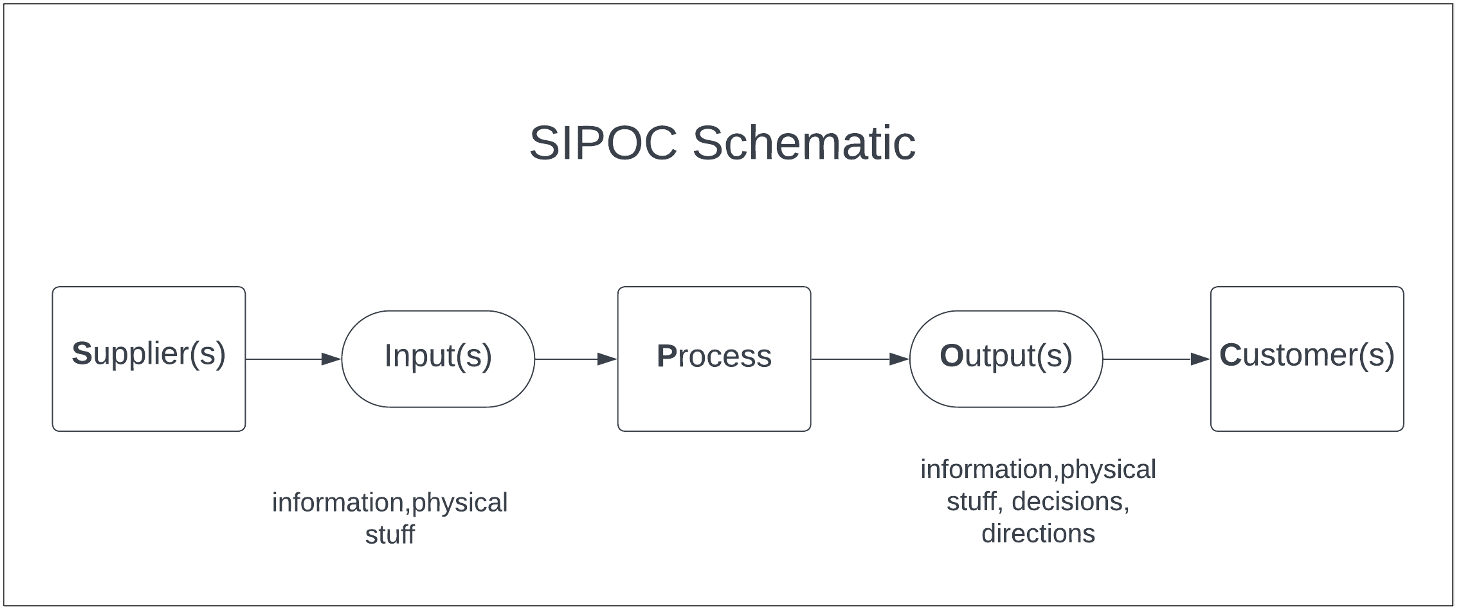
Simple linear pictures, like the Supplier-Input-Process-Output-Customer schematic, obscure this distinction.
For many years, I failed to simultaneously think and see process and operations. I’d get sucked into paying attention to operational details. Shingo insisted that process analysis and improvement has a higher priority than operations analysis and improvement.
Helen’s team at Wood River and the Story Construction leaders have put Shingo’s advice into practice. At Wood River, focus on flowing patients to appointment slots to increase the number of patients receiving care. At Story, focus on conditions rather than standardizing and optimizing individual worker tasks.
Acknowledgments
Thank you to Helen Bell for permission to share her work at Wood River Health.
LeanFrontiers regularly offers free short webinars that present examples from a range of industries. I’ve found the series gets me thinking and reinforces the fundamentals of improvement. Take a look at their offerings!