



Maintenance Is What Keeps Everything Going
It is the nature of things to change and become more disordered. Buddhist wisdom tradition is anchored in holding this nature clearly.
Our bodies, a miracle of self-repair given sufficient clean water, safe food, supportive social connections, and luck, wear out sooner or later.
Nonetheless, we can often keep ourselves and other things going for some time without being too attached to the idea that they will keep going forever.
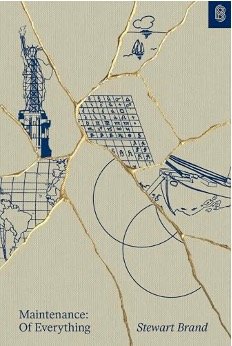
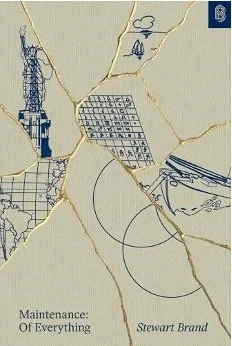
In Maintenance: Of Everything, Part I (Stripe Press, 2025), Steward Brand, the force behind the Whole Earth Catalog and related projects, reflects on maintenance as a means to keep things going.
He starts this way:
“Maintenance is absolutely necessary and maintenance is optional. It is easy to put off, yet it has to be done. Defer now, regret later. Neglect kills.” (p. 9)
How to address this fundamental tension between necessity and deferred action?
“[Expand] the term ‘maintenance’ beyond referring to only preventive maintenance to stave off the trauma of repair—brushing the damn teeth, etc. Let ‘maintenance’ mean the whole grand process of keeping a thing going. From that perspective, occasional repair is part of the process. Close monitoring is part of the process. Changing the oil is part of the process. Eventually replacing the thing is part of the process.” (p. 9)
Importantly, maintenance implies responsibility:
“When you take responsibility for something, you enter into a contract to take care of it.” (p. 10)
The language of Change: Where does maintenance fit?
I reviewed verbs and nouns useful in thinking about change in this 2021 post.
Here’s the table of verbs:
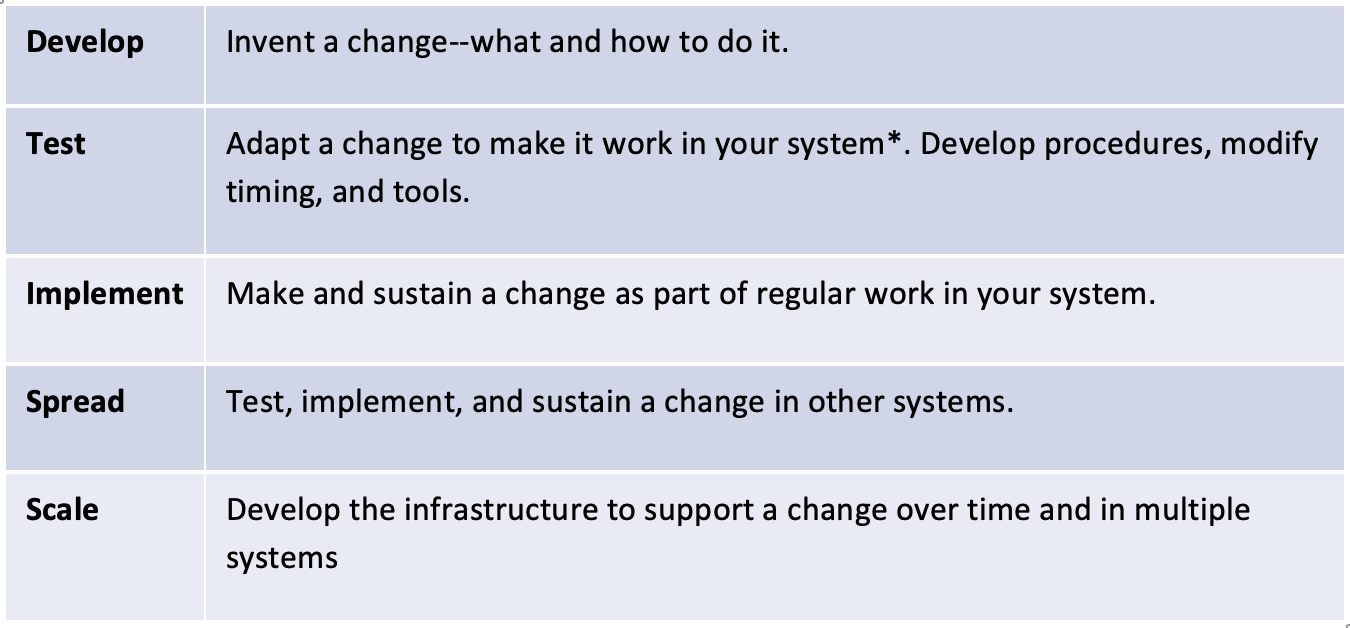
*By system, I use this definition from The Improvement Guide, p. 37: “A system is an interdependent group of items, people, or processes with a common purpose… In a system, not only the parts but the relationships among the parts become opportunities for improvement.” As systems are typically nested, ‘your system’ is almost surely a subsystem of a larger system.
Brand’s version of maintenance — occasional repair, close monitoring, eventual replacement — aligns with how I understand the word “sustain” in the definition of “implement.”
Applying Brand’s view, successful implementation requires living up to the terms of a contract to care for the system that you’ve changed.
Extensions and Connections
Another Change Verb?
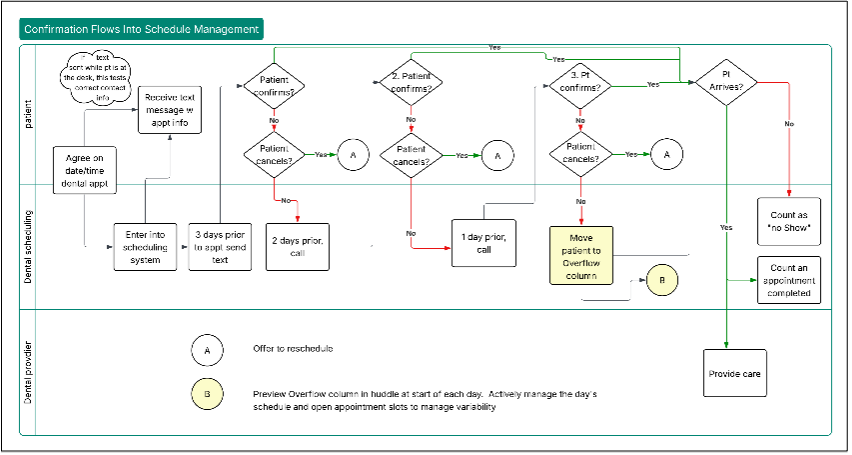
The neat five-verb sequence provides a solid framework to guide our thinking about system changes. In the last couple of years, I’ve thought about adding one more verb, between Develop and Test. Here’s how I presented it to a current group of health centers working to integrate oral health with care for patients with diabetes. The integration involves about two dozen changes to clinic workflows.

You can argue with me that Explore is a kind of Test and an unnecessary complication of the original table. However, explicit use of Explore opens the door to Alison Gropnik’s insight into learning and has helped me support the health center teams as they modify their care systems. Advising teams to explore a change seems to lower the barrier to starting to learn by doing and allows a gentle introduction to PDSA formality.
More on Brand’s book
My daughter pointed out that the book's cover evokes Kintsugi, the Japanese art of pottery repair.
Brand continues to extend his reflections on maintenance; you can find the current state of his evolving project here at the Works In Progress website.
In a recent review, Lee Vinsel did not enjoy the Brand’s digressive style. More importantly for prospective readers, he asserts that Brand treats maintenance as an “unalloyed good”, ignoring the social and environmental context of maintenance that requires weighing broader considerations. See Lee Vinsel, “Tool Use”, MIT Technology Review, May/June 2026 Vol 129 #3. pp. 68-72. https://www.technologyreview.com/2026/04/17/1135408/book-review-stewart-brand-fixing-everything-maintenance/.